Sri Lanka Currency & Payments Guide: ATMs & Exchange (2027)
Planning a trip to Sri Lanka brings plenty of excitement—from misty hill country train rides and ancient cultural sites to golden southern beaches and wildlife safaris. Amid all the itinerary planning, one practical question sits near the top of every traveller’s checklist: how does money work in Sri Lanka?
Understanding the local currency, knowing where to get fair exchange rates, avoiding unnecessary ATM fees, and knowing when you need cash versus a card will save you time, stress, and money throughout your holiday.
This practical 2027 Sri Lanka currency and payments guide covers everything international travellers need to know before arriving on the island.
💵 Understanding Sri Lanka’s Currency (LKR)
The official currency of Sri Lanka is the Sri Lankan Rupee, abbreviated as LKR and commonly written locally as Rs.
Banknotes and Coins in Circulation
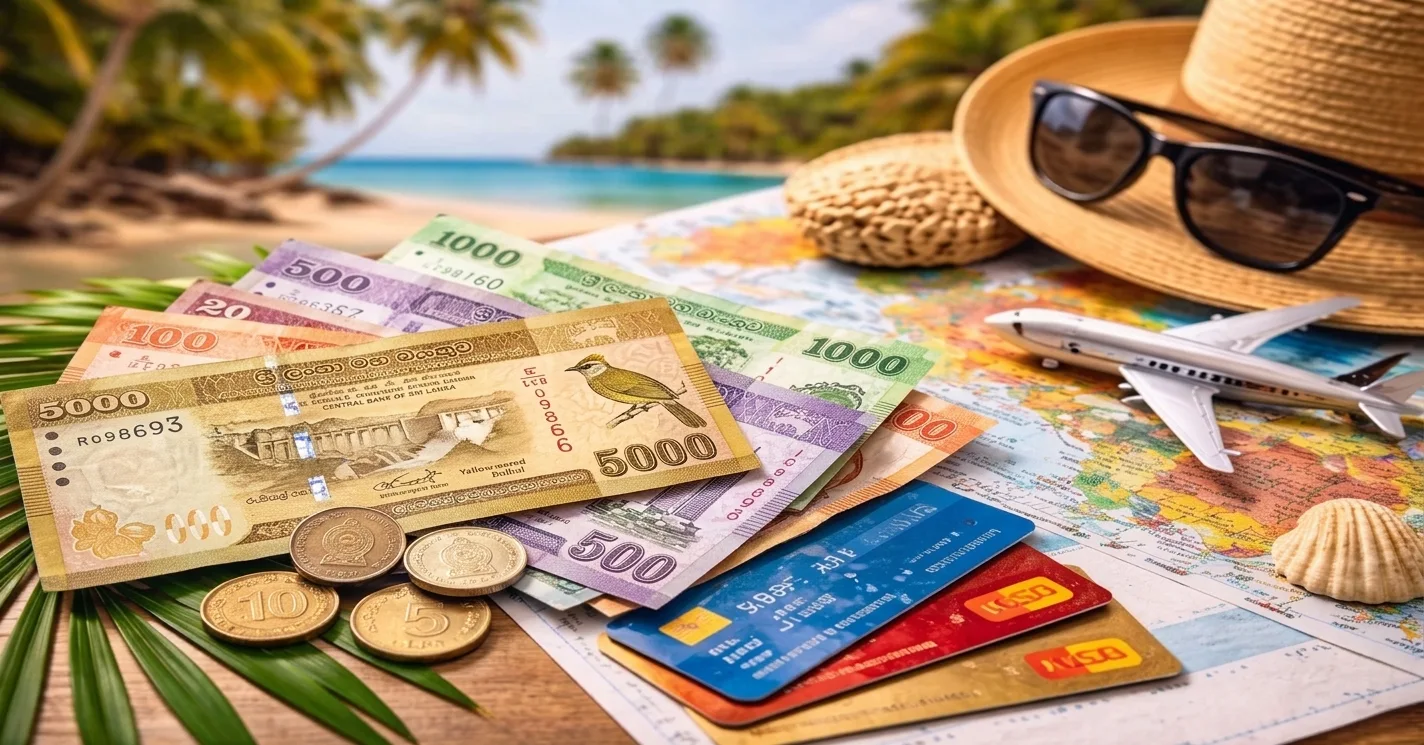
- Banknotes: LKR 20, LKR 50, LKR 100, LKR 500, LKR 1,000, LKR 2,000, and LKR 5,000.
- Coins: LKR 1, LKR 2, LKR 5, LKR 10, and LKR 20 (coins are used mostly for small local purchases, buses, and exact change).
💡 Important Note on Foreign Currency: While upscale hotels, luxury resorts, and certain international tour bookings may quote prices in USD or EUR, everyday payments across Sri Lanka are made in Sri Lankan Rupees (LKR). Always carry local currency for day-to-day travel.
💱 Best Places to Exchange Money in Sri Lanka
If you are bringing foreign cash—such as USD, EUR, GBP, AUD, CAD, or SGD—choosing the right place to exchange your money makes a noticeable difference.
1. Bandaranaike International Airport (CMB) Arrival Lobby
Unlike many international airports where currency desks offer poor rates, the arrival hall at Colombo’s Bandaranaike International Airport features official counters run by major Sri Lankan banks (such as Bank of Ceylon, Commercial Bank, and Sampath Bank).
- Why it is great: Exchange rates at the airport bank counters are regulated and almost identical to city bank branches.
- Pro Tip: Exchange enough money at the airport to cover your first two to three days of transport, meals, and tips. Keep your official exchange receipt—you will need it if you wish to convert unused rupees back into foreign currency at the departure terminal before flying home.
2. Licensed Money Changers in Major Cities
In busy commercial and tourist hubs—such as Colombo (particularly Fort and Pettah), Negombo, Kandy, and Galle—authorized private money changers often provide slightly better rates than commercial banks with zero commission charges. Always ensure the shop displays an official license from the Central Bank of Sri Lanka.
3. Local Commercial Banks
Major banks across the island exchange foreign currency safely and reliably. You will need to present your passport, and the transaction may take 10–15 minutes depending on queues.
❌ Where to Avoid Exchanging Money
- Hotels and Resorts: Convenience comes at a cost; hotel exchange rates are typically much lower than bank or licensed money changer rates.
- Unlicensed Street Touts: Never exchange cash with individuals approaching you on the street.
💵 Condition of Foreign Banknotes Matters
Sri Lankan banks and money changers are strict about the physical condition of foreign currency—especially US Dollars. Bring crisp, clean, recent-edition banknotes with no tears, ink marks, heavy creases, or missing corners, as damaged notes are routinely rejected.
🏧 Using ATMs in Sri Lanka: Fees, Limits & Smart Tips
ATMs are easy to find in Colombo, Negombo, Kandy, Ella, Nuwara Eliya, Galle, Mirissa, Dambulla, and other popular tourist towns. However, machines become scarce in rural villages and near remote national park entrances, so plan ahead before heading off the beaten path.
Most Reliable Banks for International Cards
Stick to ATMs belonging to major, established Sri Lankan banks, which reliably accept international Visa and Mastercard debit and credit cards:
- Commercial Bank of Ceylon
- Sampath Bank
- Hatton National Bank (HNB)
- Bank of Ceylon (BOC)
- Nations Trust Bank (NTB)
ATM Fees and Withdrawal Limits
- Local ATM Fees: Most Sri Lankan banks charge a flat foreign-card withdrawal fee of roughly LKR 500 to LKR 1,000 per transaction (fees are subject to change, so check the on-screen prompt before confirming). Your home bank may also apply its own international ATM or foreign exchange fee.
- Withdrawal Limits: Single withdrawals generally range between LKR 40,000 and LKR 100,000, depending on the bank and your card’s daily limit. Commercial Bank and Sampath Bank often permit higher single-transaction limits.
⚠️ Golden Rule: Always Choose “Without Conversion”
When using a Sri Lankan ATM (or paying by card at a shop), the screen may ask whether you want to be billed in LKR or your home currency (Dynamic Currency Conversion).
- Always select LKR (Without Conversion). Letting the local ATM or terminal convert the currency adds an unnecessary markup of 3% to 7%.
💳 Cards vs. Cash: Where Each Payment Method Works Best
Sri Lanka is steadily modernizing its payment infrastructure, yet cash remains essential once you step outside hotels, supermarkets, and upscale restaurants. Carrying a smart mix of both is the best approach.
Where Credit & Debit Cards Are Widely Accepted
- Mid-range to luxury hotels, boutique stays, and resorts
- Upscale restaurants and specialty cafés in Colombo, Galle Fort, Kandy, Ella, and south-coast surf towns
- Major supermarkets (Keells, Cargills Food City, Arpico)
- Larger clothing stores, gem/jewelry showrooms, and established souvenir shops
- Ride-hailing apps (PickMe and Uber) when linked in advance
Card Tips to Keep in Mind:
- Visa and Mastercard are accepted almost everywhere that takes cards. American Express (Amex) has limited acceptance outside high-end hotels and major supermarkets.
- Card Surcharges: Some smaller guesthouses, local restaurants, and independent shops add a 2.5% to 3.5% processing fee for card payments. Always ask before tapping or inserting your card.
- Contactless Payments: Apple Pay and Google Pay work at modern POS terminals in major cities and supermarkets, though having your physical card is still essential.
Where You Will Need Cash (LKR)
- Tuk-tuks and local public buses
- Street food stalls, local bakeries, and traditional rice-and-curry eateries
- Small family-run guesthouses and homestays
- Fruit stalls, local markets, and village shops
- Tips for private drivers, safari jeep drivers, tour guides, and hotel porters
💡 Keep Small Denominations Handy: Tuk-tuk drivers, small cafés, and local vendors rarely carry enough change for an LKR 5,000 (or even LKR 2,000) note on small fares. Break large bills at supermarkets, hotels, or restaurants whenever you get the chance, and keep plenty of LKR 100, LKR 500, and LKR 1,000 notes in your wallet.
🧭 Practical Money Checklist for Your 2027 Sri Lanka Trip
- Notify your bank before flying: Inform your home bank of your travel dates in Sri Lanka so automated fraud filters do not block your cards.
- Carry two cards from different networks: Having both a Visa and a Mastercard stored separately gives you peace of mind if one card is lost, damaged, or temporarily blocked.
- Use ATMs attached to bank branches: Whenever possible, withdraw cash during daytime hours at ATMs located inside or directly outside an open bank branch.
- Bring a small emergency cash reserve: Keep USD 100–200 (or equivalent in EUR/GBP) in clean notes locked safely in your luggage as a backup, especially around Sri Lankan public holidays (such as monthly Poya full-moon days) when banks are closed and ATMs can occasionally run low on cash.
- Tipping Etiquette: Tipping is not mandatory in Sri Lanka, but it is warmly appreciated in the hospitality sector. For great service, consider LKR 200–500 for hotel porters, 10% at restaurants if a service charge is not already included on the bill, and a daily tip at the end of your trip for dedicated private chauffeur-guides and safari drivers.
(Note: Banking regulations, ATM fees, and entrance ticket payment policies across Sri Lanka can change periodically. Always confirm the latest payment requirements with your accommodation or tour operator prior to travel.)
🚐 Travel Stress-Free Across Sri Lanka with Haven Lanka Tours & Holidays
Navigating currency exchanges, calculating daily cash needs, and negotiating local transport fares shouldn’t take away from enjoying your holiday. When you travel with Haven Lanka Tours & Holidays, your private vehicle, experienced English-speaking chauffeur-guide, fuel, and core itinerary logistics are arranged transparently in advance—so you can focus on soaking up Sri Lanka’s culture, wildlife, and landscapes without hidden surprises.
Whether you are planning a customized multi-day round tour, a wildlife safari adventure, a cultural discovery trip, or seamless airport transfers anywhere on the island, our local team is here to help you plan every detail.
📩 Contact Haven Lanka Tours & Holidays Today
- Website: https://havenlanka.com
- WhatsApp: +94 71 935 3418
- Email: info@havenlanka.com
Your Local Partner for Authentic Sri Lankan Experiences.
❓ Frequently Asked Questions (FAQs)
1. Should I exchange money before arriving in Sri Lanka or after landing?
It is best to bring major foreign currency (such as USD, EUR, or GBP) in cash and exchange it after landing at the official bank counters in the Bandaranaike International Airport (CMB) arrival lobby. Rates at Colombo Airport bank counters are very competitive, whereas buying Sri Lankan Rupees abroad usually involves poor exchange rates.
2. Are US Dollars accepted in Sri Lanka?
US Dollars are accepted by some luxury hotels, resorts, and international tour operators, but everyday businesses—including restaurants, supermarkets, tuk-tuks, and local shops—only accept Sri Lankan Rupees (LKR). Always carry local currency for daily expenses.
3. Can I use credit and debit cards everywhere in Sri Lanka?
No. Visa and Mastercard are widely accepted at mid-range and luxury hotels, supermarkets, and upscale restaurants in tourist towns, but Sri Lanka remains largely cash-based for tuk-tuks, local eateries, small guesthouses, and rural areas.
4. Which ATMs are best for foreign tourists in Sri Lanka?
ATMs operated by Commercial Bank, Sampath Bank, Hatton National Bank (HNB), and Bank of Ceylon (BOC) are the most reliable for international Visa and Mastercard users. Always choose to be charged in LKR (Without Conversion) to avoid extra currency conversion markups.
5. How much cash should I carry per day in Sri Lanka?
For everyday spending—such as lunches, snacks, bottled water, tuk-tuks, and small tips—carrying around LKR 5,000 to LKR 15,000 per day in small denominations (LKR 100, 500, and 1,000 notes) is comfortable for most travellers, assuming major hotel bills are paid by card.
6. Are banks and money changers open on Poya (Full Moon) holidays in Sri Lanka?
No. Every monthly full-moon Poya Day is a public holiday in Sri Lanka, meaning commercial banks are closed. However, ATMs remain operational 24/7, and bank counters at Colombo International Airport operate around the clock every day of the year.